Choosing a Post Driver for Your Skid Steer: What to Know Before You Buy
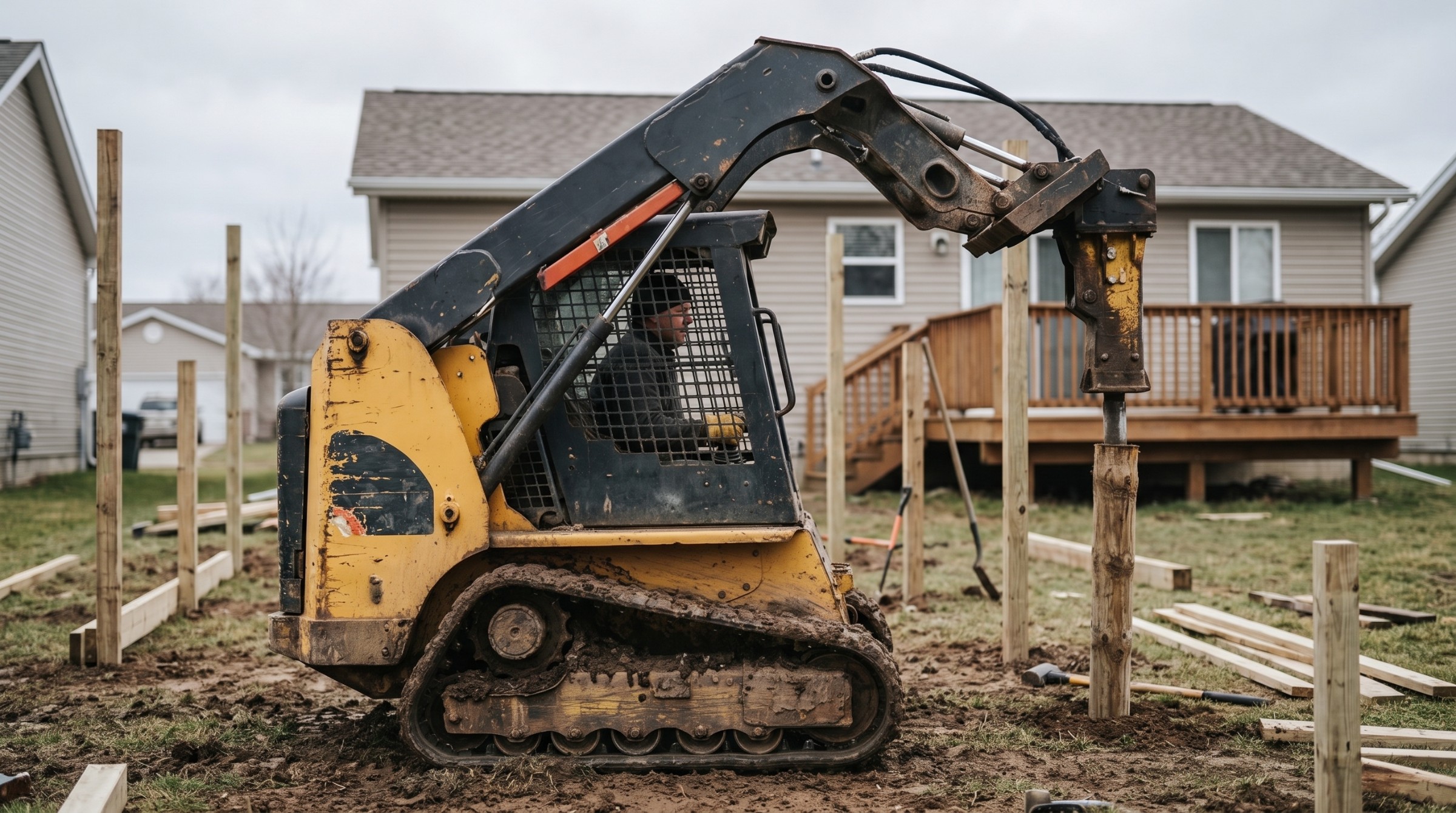
If you're fencing more than a few hundred feet, a manual post pounder stops being practical fast. A hydraulic post driver mounted to a skid steer changes the math entirely, letting one operator drive posts at a pace that would take a crew all day by hand. But not every driver fits every machine or every job, and buying the wrong one costs you more than the price difference. Here's what to think through before you pull the trigger.
How Skid Steer Post Drivers Work
A hydraulic post driver attaches to your skid steer's auxiliary hydraulic circuit and uses that flow to cycle a hammer head up and down, driving the post into the ground with each stroke. The machine's weight keeps the driver planted while it works, and the operator controls everything from the cab. No swinging, no fatigue, and no ground crew having to hold posts steady.
Flow requirements matter. Most skid steer post drivers need somewhere in the range of 10 to 25 gallons per minute to operate efficiently. Pair a high-output driver with a machine that can't supply enough flow and you'll get sluggish cycle times. Check your skid steer's aux hydraulic spec before you start comparing models. That single number will eliminate a lot of options on its own.
Round Posts vs. Steel T-Posts: The Driver Spec Changes
Not all post drivers handle every post type equally well. Most hydraulic skid steer drivers are built around a cup or sleeve that captures the post head, and the sleeve diameter is matched to a post size range. A driver sized for steel T-posts won't seat a 6-inch round post correctly, and vice versa.
If your project mixes materials, say a board fence perimeter with wood corner posts and T-posts running the interior, you either need a driver with interchangeable heads or to plan the job so you're running one post type at a time. Treated wood fence posts in the 4-inch and 5-inch range are the most common request we see for skid steer drivers, though larger landscape posts and agricultural corner posts push toward 6 inches and up. Know your post diameter before you decide on a model.
Ground conditions play into this too. Sandy or loamy soil drives easily and doesn't demand much from the driver. Clay, rocky ground, or frozen soil in late fall requires a heavier impact head and more hydraulic force behind each stroke. Undersizing the driver for your soil type means fighting the machine the whole day.
What the Montana 750r Gets Right
The Montana 750r is one of the models that shows up consistently in search data for skid steer post drivers, and there's a practical reason for it. It's built for mid-to-large skid steers, handles a solid range of post diameters, and cycles quickly enough to keep up with production fencing. It also has a straightforward mounting setup that doesn't require fabrication work to attach to most common skid steer quick-attach plates.
For farm fencing, rural property lines, and heavier agricultural work, it hits the right balance of capacity and compatibility. If you're looking at a driver for a mix of treated lumber fence posts and light utility pole installation on a working farm, the 750r is worth a close look. You can see the full spec on our post drivers product page.
That said, the right driver is always the one that matches your specific machine's hydraulic output and your typical post size. A model that's overkill for occasional residential use might be exactly right for someone driving 500 posts a week across multiple properties.
Pairing the Driver With the Right Posts
A fast driver paired with undersized or the wrong type of posts creates its own problems. Soft, untreated wood can split under impact, especially in cold weather. For ground-contact applications, pressure-treated posts rated for direct burial are the baseline. Legacy Post & Supply mills and supplies pressure-treated fence posts sized for the kind of volume fencing jobs that justify a skid steer driver in the first place.
If your project includes heavier structural posts, gate corners, or landscape posts for entry markers and load-bearing applications, those may need a pre-drilled pilot hole or a different installation approach than a standard driver cup allows. It's worth confirming the driver head will seat correctly on your specific post type before you're standing in the field trying to make it work.
Ready to talk through what you're building? Submit a quote request and we can help you match the right posts to your driver setup, or reach out to us directly if you'd rather talk it through first.
Quality You Can Trust
Experience the quality of Legacy Post & Supply products firsthand. Contact us today to discuss how we can help or to request a free quote.